
Two weeks after eye surgery, 13-year-old Kenzie Omit stepped up to the bowling lane—without glasses—and delivered strike after strike.
Kenzie, a seventh grader at Nikolay Middle School in Cambridge, WI, has spent most of her life at the bowling alley. She picked up the sport at just five years old after her mom mentioned a local youth league. Kenzie decided to give it a try—and was hooked from the start.
By the age of nine, Kenzie began having problems with her eyesight. “I started noticing that I couldn’t see the board at school very well,” she recalled. “It was all fuzzy.”
After failing a routine school vision screening, her family scheduled an eye exam—expecting she might simply need glasses.
What they learned instead was shocking.
“We found out Kenzie had full-blown cataracts in both eyes,” said Nikki Omit, Kenzie’s mom. “We were stunned to learn she was born with them.”
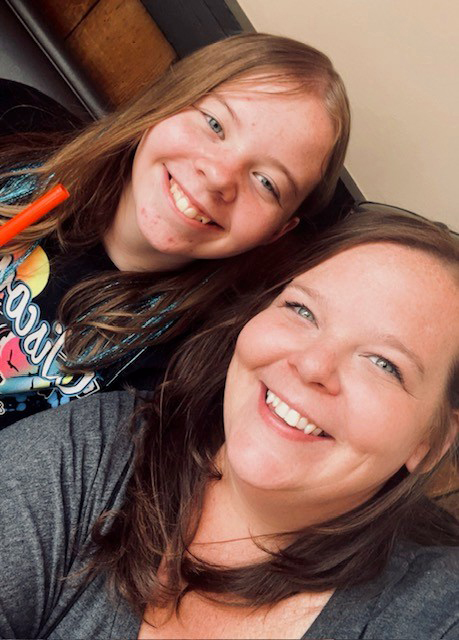
A local optometrist referred Kenzie to UW Health, where Kenzie met Dr. Yasmin Bradfield, a specialist in pediatric ophthalmology and adult strabismus. Dr. Bradfield confirmed the diagnosis: bilateral cataracts, a clouding of the lenses in both eyes.

Cataracts like Kenzie’s—occurring in children—are rare. “Pediatric cataracts occur in only 3 to 4 infants per 10,000,” explained Dr. Bradfield. “Most bilateral cataracts have no underlying identical cause, but they can be hereditary. Certain medical conditions or infections before birth can also play a role.”
In the beginning, Kenzie’s cataracts were small enough that glasses helped. But over time, the cataracts grew until they covered the entire back of her eye. “My vision grew cloudier,” Kenzie said, “and without glasses, my eyes ached all the time.”
In the summer of 2025, Kenzie had surgery on her left eye. “We wanted school to be out, since recovery is long,” Nikki said. Kenzie finished school on a Friday and was in the operating room the following Monday.
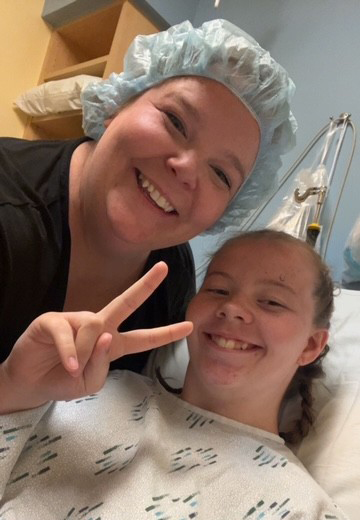
“I was really nervous,” Kenzie admitted. “I cried the whole way to the hospital. But afterward, even though I was scared, I knew my problems were 50% fixed. That helped a lot.”
The improvement was immediate. Prior to surgery, Kenzie’s vision was 20/100. But the next morning, her left eye tested at 20/40—an enormous jump from where she’d been.
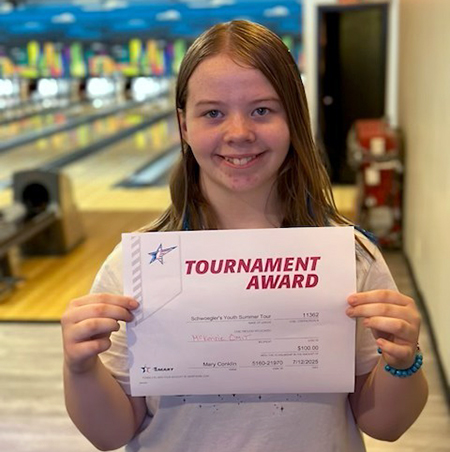
As that eye grew stronger, however, her right eye weakened, forcing her to rely almost entirely on the newly repaired one. But, Kenzie refused to let that slow her down. Just a couple of weeks later, in early July, she competed—without glasses—in a local youth bowling tournament. She took first place and won a scholarship.
In late July, Kenzie underwent surgery on her right eye. Standard care would have placed the second surgery within one to two weeks of the first, but an insurance delay pushed it back. Even so, both procedures were highly successful. Regardless, both surgeries were highly successful. Today, Kenzie sees 20/30 without glasses.
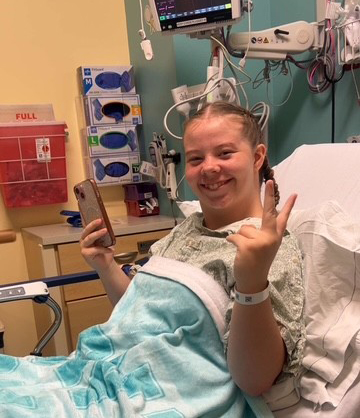
“It’s incredible,” she said. “I can see more clearly. And I can see images and colors more vibrantly.”
“And her beautiful blue eyes aren’t hidden behind glasses anymore,” added Nikki.
From here, Kenzie’s care plan is simple: yearly check-ups, like any other eye patient. “Kenzie had an excellent recovery with excellent vision quickly after surgery,” said Dr. Bradfield. “Sometimes patients need to be in their new glasses for a while before their vision gets better, but that was not the case for Kenzie.”

The family credits Dr. Bradfield for guiding them through the journey. “She is incredibly good at what she does,” Nikki said. “She kept us informed the whole way. We highly recommend her.”
With her vision restored, Kenzie is already looking ahead to her next bowling tournament. Her advice to other kids facing a similar challenge?
“Don’t be scared. Everything will work out.”