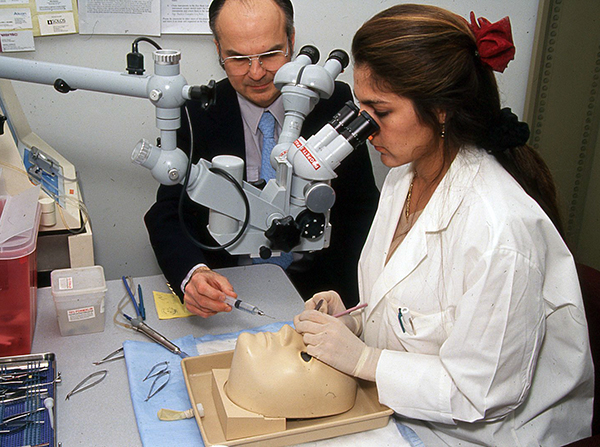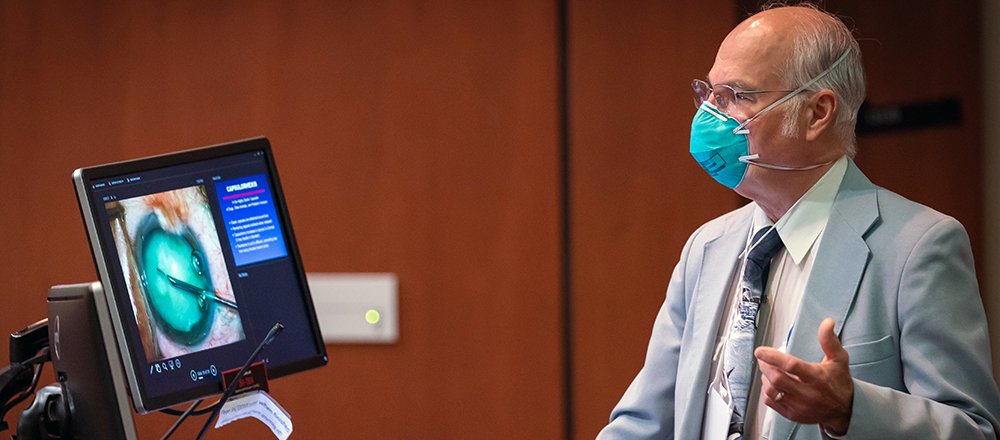
For more than three decades, ophthalmology residents at the University of Wisconsin—Madison—and their veterinary ophthalmology counterparts—have walked into the cataract surgery wet lab to find the same reassuring presence. A calm confidence and a pair of hands that seemed to know instinctively when to guide, when to correct, and when to simply let a learner try.
To generations of trainees, Daniel Fary, MD has been the quiet constant behind one of the most delicate skills they will ever learn. Now, at 79 years old, after 31 years in the wet lab, he is preparing to hand over the reins this June.
A Mechanical Mind Finds Its Calling
Long before he ever held a surgical instrument, Daniel Fary was the kid who wanted to climb telephone poles for Bell Telephone. Anything mechanical—electronics, tools, anything that could be taken apart and rebuilt—captured his imagination.
Dr. Fary admits he didn’t set out to become an ophthalmologist. After earning his medical degree from Indiana University Medical School in 1974, he began a family medicine residency. Two elective rotations in ophthalmology changed everything.
“I realized that family doctors didn’t know much about eyes,” Dr. Fary recalled. “And I discovered that I really liked the field, the tiny instruments, the delicate microscopic surgeries.”
He switched residencies and completed ophthalmology training in 1979. After that, he practiced general ophthalmology in Beaver Dam and Fort Atkinson. He joined the Department of Ophthalmology and Visual Sciences (DOVS) as a clinical assistant professor in 1985.
His mechanical instincts never left him. Over the years, he coaxed aging equipment into longer life and even designed his own cannula and an intraocular lens—the ORC “C580H,” a 7 mm, 10° posteriorly angulated model.
The Birth of a Training Tradition
Dr. Fary’s involvement in the cataract wet lab—now a cornerstone of the department’s curriculum—began with a chance encounter at the American Academy of Ophthalmology meeting in Chicago in 1993. There, he ran into Fred Brightbill, MD, then chair of external disease, who asked him if he’d help staff a new cataract wet lab. Dr. Fary said yes—and never looked back.
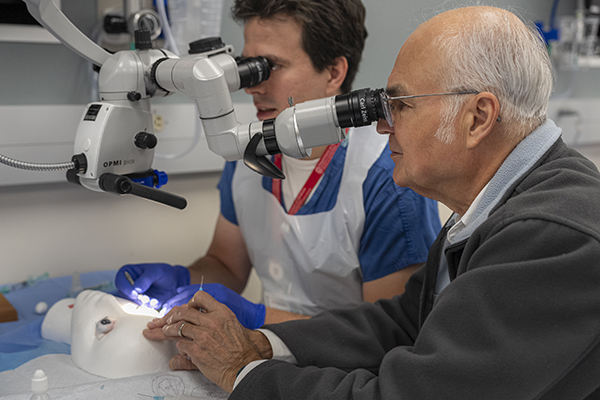
The program was also shaped by collaboration across campus. The program was built through collaboration between the medical and veterinary schools. Chris Murphy, DVM, who led the School of Veterinary Medicine’s ophthalmology service at the time, played a key role in establishing the wet lab and ensuring veterinary ophthalmology trainees participated alongside medical residents.
When the lab opened a year later, Dr. Fary became one of its earliest and most enduring teachers. Even after retiring from clinical practice in 2009, he continued showing up, month after month, to teach.
Anna Momont, MD, vice chair of resident education, reflects on the impact of that commitment: “Dr. Fary has devoted countless hours to training residents on the basics of microsurgery. When we sit down with these trainees for their first cataract cases, they are well prepared—and we are confident they can provide excellent patient care.”
Teaching Through Touch
Most residents arrive at the wet lab having seen only one or two cataract surgeries. Dr. Fary meets them where they are. When a learner struggles, he doesn’t take over. He simply places his hands over theirs, gently guiding the instrument into a more effective motion. It’s a subtle correction, a quiet confidence transferred through touch.
Once a resident completes their first full procedure, he steps back even more.
“This is your time to play,” he tells them. “Do whatever you feel would be most valuable for you.”
“This was their ‘free time’ to not have to worry about mistakes or poor outcomes,” Dr. Fary recalls, “It was a time to learn from misadventures and enjoy the time of learning during which they couldn’t make a mistake. No matter what they did, it was only a learning experience they could benefit from.”
Breanna Aldred, MD, a 2025 ophthalmology residency graduate, remembers that approach vividly. “Dr. Fary is an incredible teacher and taught me the basics of cataract surgery during our wet labs with pig eyes. His teaching was comprehensive—from learning the names of and how to hold the different instruments, to the different steps of surgery, to the intricacies of the phacoemulsification machine. He has an obvious passion for teaching, and our time together helped me feel confident and prepared to operate on my patients.”
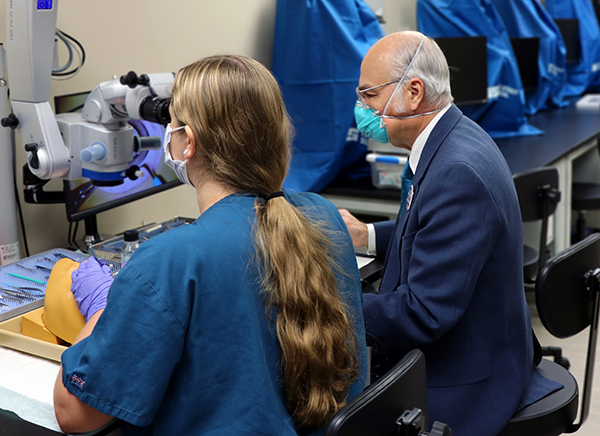
In 2017, DOVS honored Dr. Fary with the Distinguished Community Educator Award, recognizing the countless careers shaped by his mentorship.
Passing the Torch
When Dr. Fary steps away from the wet lab this summer, he will hand the program to another familiar face, Thomas Castillo, MD. But retirement, for him, hardly means slowing down.
“I’ve always worked with tools and mechanical concepts. I don’t feel whole unless I have that kind of engagement. I have dozens of projects I’d like to get done, but I’m continually repairing or building small things, maintaining our net‑zero energy home, supporting wildlife in our rural yard, and keeping up with projects in the prairie and woods. And Jane and I spend more time with our kids and grandkids than I might have guessed.”
Patty Saab, MD, the first ophthalmology resident Dr. Fary trained who is still a DOVS faculty member, sums up what many feel: “I am grateful for Dr. Fary’s encouragement and willingness to invest his time and energy into my surgical training. His insight and knowledge helped shape my professional success.”