Artificial intelligence (AI) is rapidly reshaping everyday life—and for people who are blind or have low vision, it holds growing promise as a tool for greater independence.
At the University of Wisconsin—Madison (UW), a cross-disciplinary team is working to turn that promise into practical solutions. Led by the Department of Ophthalmology and Visual Sciences (DOVS) and the Department of Computer Sciences, the AI-Assisted Vision Workshop on Intelligent Assistive Technologies for Blind and Low Vision Individuals brings together researchers, clinicians, technologists, and community members to rethink how assistive tools are designed.
Now in its second year, the initiative convened partners from the UW, the University of Texas at Dallas, and the University of Washington for a half-day workshop in Madison on May 13. But the project’s focus extends well beyond a single event.
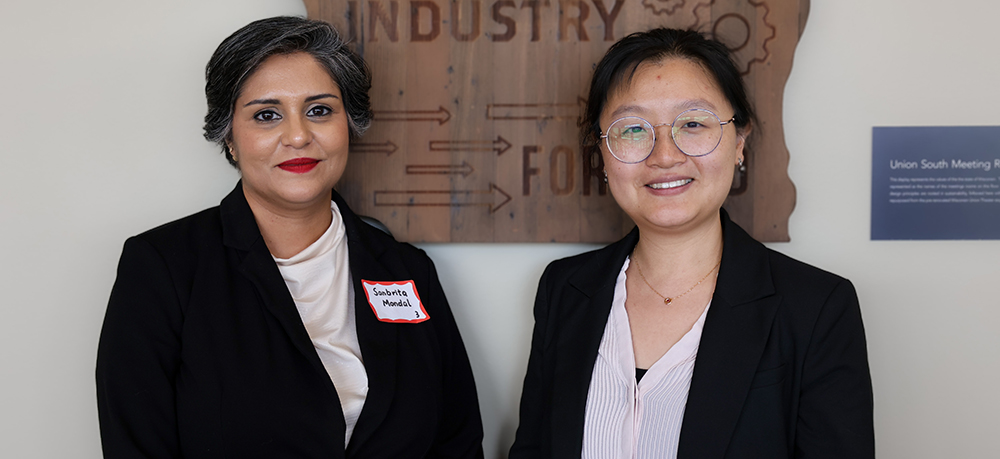
“Most low vision aids have historically been developed by sighted researchers,” said Sanbrita Mondal, OD, Chief of Vision Rehabilitation Services in DOVS. “We’re working to change that by directly engaging people with low vision in design strategies to better understand their daily challenges and priorities, and how aids may be enhanced.”
That engagement is central to the project’s approach. Participants from organizations including the Wisconsin Council of the Blind & Visually Impaired, the Wisconsin Office for the Blind & Visually Impaired, Vision Forward, the National Federation of the Blind (Dane County Chapter), the McPherson Eye Research Institute, and UW Health Vision Rehabilitation Services contributed insights alongside academic researchers.
Yuhang Zhao, PhD, assistant professor of computer sciences and principal investigator on the project, emphasizes the urgency of the work.
“Low vision is a complex and widespread condition that affects millions of people, yet it remains underrepresented in technology research,” Dr. Zhao said. “To create truly effective tools, we need a deeper understanding of users’ lived experiences and the flexibility to design technologies that adapt to their environments and preferences.”
The team is focused on addressing challenges that arise in dynamic, real-world settings—such as cooking a meal or navigating a crowded street. These tasks require constant movement, multiple sensory inputs, and interaction with objects. Traditional aids such as magnifiers often fall short by distorting vision or obscuring critical details.
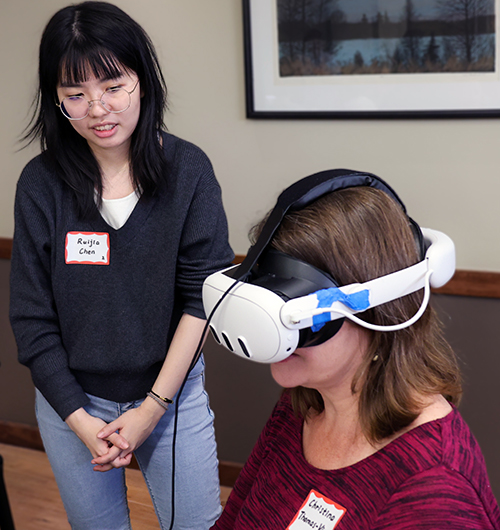
Through lectures, demonstrations, poster sessions, and open discussion, the workshop fosters collaboration and accelerates innovation across disciplines. More importantly, it creates space for the low vision community to directly shape the future of assistive technology.
“The ultimate goal is to develop AI-powered tools that are not only more effective, but more intuitive, responsive, and widely adopted by the people they are designed to serve,” said Dr. Mondal.
This workshop is supported by the Departments of Computer Sciences and Ophthalmology and Vision Sciences at the University of Wisconsin—Madison.