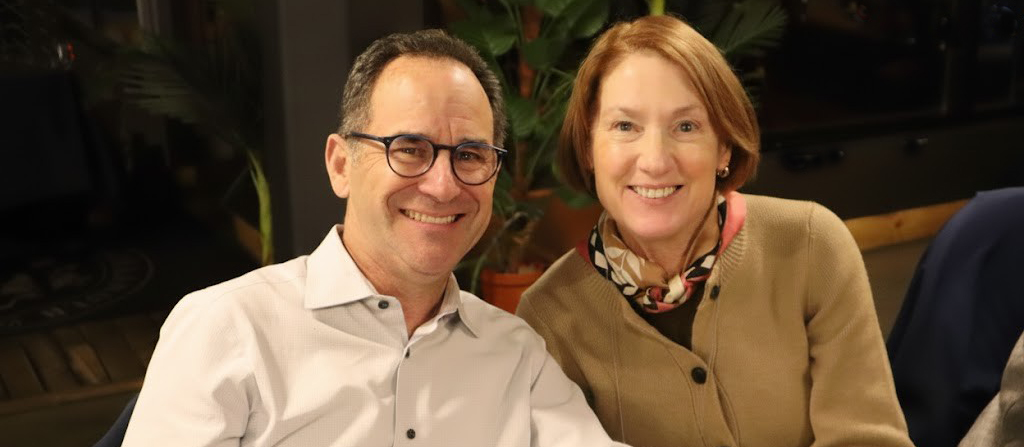
When Drs. Barbara Blodi and Justin Gottlieb arrived at the University of Wisconsin (UW) Department of Ophthalmology and Visual Sciences (DOVS) three decades ago, they brought with them a shared passion for retina care and a focused commitment to academic medicine, balancing all with a growing family.
As they prepare to retire at the end of June of 2026, they leave behind an extraordinary legacy that has shaped generations of learners and improved the lives of thousands of patients.
Their story began in 1992 at the University of Michigan Kellogg Eye Center in Ann Arbor, where Dr. Blodi was a new retina fellow and Dr. Gottlieb a second-year ophthalmology resident. At a welcome picnic, they quickly discovered they shared not only a passion for ophthalmology, but also remarkably similar backgrounds and values.
“Both our fathers were ophthalmologists,” Dr. Gottlieb said. “And we shared similar experiences growing up—like talking about eye surgery at the dinner table.”
“We also came to appreciate how important family is,” Dr. Blodi said. “Both of our families were very happy. In ophthalmology, it’s not uncommon to see multiple generations enter the field after witnessing the fulfillment the profession can bring.”
The couple married in August 1994 but spent their first year apart while Dr. Gottlieb completed a medical retina fellowship at the Bascom Palmer Eye Institute of the University of Miami in Florida and Dr. Blodi remained on faculty at the University of Michigan.
“We knew the airports well and made it work,” Dr. Blodi said.
The following year, they moved together to Philadelphia, PA where Dr. Gottlieb began a surgical retina fellowship at the Wills Eye Hospital of the Thomas Jefferson University, and Dr. Blodi worked in private practice.
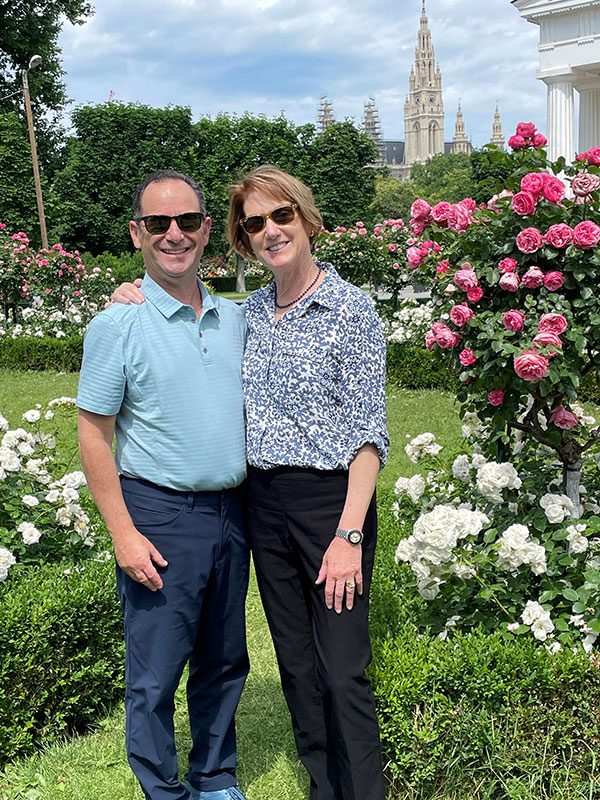
Then came an unexpected opportunity.
During his fellowship, one of Dr. Gottlieb’s mentors walked into the operating room carrying a recruitment letter from the UW.
“He raved about what a great program it was,” Dr. Gottlieb recalled. “I had received advertisements from the same program but routinely discarded them. I grew up in the Southeast and didn’t think I’d ever end up in the Midwest.”
When he brought the letter home, Dr. Blodi, who grew up in Iowa, immediately recognized the opportunity.
“I’ve always loved Madison,” she said, “and was excited about it. I wasn’t sure he’d go for it, but we decided to visit.”
In February.
“The weekend we came, it was about 30 degrees,” Dr. Gottlieb said. “We went ice skating with friends. There was a beautiful dusting of snow. It looked like a Hallmark card. I thought it was always like that in February.”
“I didn’t say a word,” Dr. Blodi confided with a laugh.
By then, they had welcomed their son, Jeremy.
“We heard amazing things about what a great city Madison was for families,” Dr. Gottlieb said.
The rest was history.
The couple joined the DOVS faculty in 1997 and went on to build distinguished careers as retina specialists, researchers and educators.
For Dr. Blodi, a defining opportunity came through the Fundus Photograph Reading Center, now known as the Wisconsin Reading Center (WRC). Within a year of joining the team, she adopted a leadership role and was pivotal in helping expand its work in age-related macular degeneration research, including the development of grading systems that advanced understanding of the disease.
Dr. Blodi currently serves as the Matthew D. Davis Professor of Ophthalmology and medical director of the WRC.
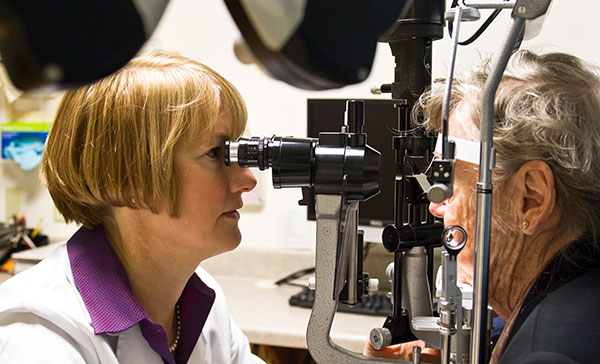
“The work we do at the WRC is built around the imaging technologies we use every day to care for patients,” Dr. Blodi said. “Because it’s highly translational research, there’s a direct connection between what we study and the treatments we ultimately provide. That’s what makes it so rewarding—you can see the impact on patient care relatively quickly.”
Reflecting on their years with DOVS, both point to the people around them as one of the department’s greatest strengths.
“When we arrived, there were faculty—like Drs. Matthew Davis, Frank Myers and Daniel Albert— who had been leaders in our department for decades,” Dr. Blodi said. “They were so good to us as we established our own practices.”
Those professional relationships evolved into lasting friendships.
“The faculty have become friends, and that’s not always true in academic medicine,” Dr. Blodi said. “We are very fortunate.”
“Madison attracts people who genuinely want to be here,” Dr. Gottlieb added. “And that has created tremendous stability within the department.”
During their careers, they watched the field of retina care advance rapidly.
“The biggest changes have been in both surgery and medical treatment,” said Dr. Gottlieb, who is a professor of ophthalmology and medical director of UW Health Eye Clinic–Rockford, IL.
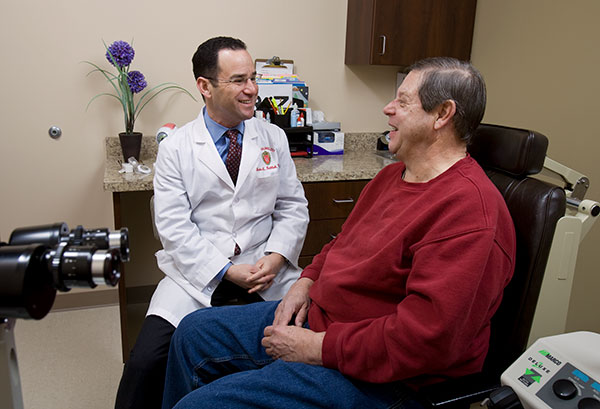
Advances in surgical equipment have made retinal procedures safer and more effective than ever before. At the same time, groundbreaking medications have transformed treatment for wet age-related macular degeneration and diabetic retinopathy.
“Twenty-five years ago, these were some of the most difficult conditions to manage as ophthalmologists because there was little we could do,” Dr. Gottlieb said. “Today, we routinely see patients whose vision has been preserved for decades because of treatments developed through research and clinical trials.”
Many of those patients are now in their 80s and 90s, still driving, reading, and living independently, enjoying the activities they love.
“We don’t have a cure yet,” Dr. Blodi said. “But we’ve come a long way in improving quality of life for many people.”
Advances in imaging have been equally transformative. Technologies such as optical coherence tomography now allow physicians to see retinal structures in extraordinary detail.
“It’s like looking at slices of a cake instead of only seeing the top,” Dr. Blodi explained. “The resolution is incredible. We can see every layer of the retina, detect disease earlier, and provide treatment sooner.”
Despite the technological advances, both physicians believe the most important aspect of medicine remains the human connection between doctor and patient.
Dr. Gottlieb advises young physicians: “Take the time to get to know your patients. It doesn’t take long to ask about their family or learn a little about who they are. Those interactions make patients more comfortable, make your day more gratifying, and remind you why you’re doing this work.”
Despite demanding careers, both say their greatest accomplishment is the family they built together.
“Our children have become happy, successful, independent people,” Dr. Blodi said.” Being able to balance family life and work is one of the things we’re most proud of.”

Today, their son Jeremy is completing MD/PhD training at the University of California, San Francisco, while their daughter, Andi, works in advertising in New York City.
Although retirement marks the end of their clinical careers, neither plans to step away completely. Dr. Blodi will continue her involvement with the WRC, while Dr. Gottlieb plans to remain active in education and mentoring medical students, residents, and fellows as an emeritus faculty member.

To honor their extraordinary contributions, the department recently renamed its retina fellowship fund the Barbara Blodi, MD and Justin Gottlieb, MD Retina Fellowship Fund.
“The recognition serves as a fitting tribute to two physicians whose partnership has strengthened the department serving as faculty pillars, advanced the field of retina understanding and care through collaborative research initiatives locally to globally, and touched countless lives through their dedication to patients, learners, and colleagues,” said Terri Young, MD, MBA, chair of DOVS. “While their presence in clinic will be deeply missed, their influence will continue for generations to come.”