Amitha Domalpally, MD, PhD, was named director of the Wisconsin Reading Center (WRC), effective July 1, 2026. In this role, Dr. Domalpally, who most recently served as WRC Research Director, will oversee all operations of the Wisconsin Reading Center. Dr. Domalpally joined the WRC in 2007 as a co-director, valued for her extensive knowledge in Auto Fluorescent Imaging and her innovative thinking.
WRC Medical Director, Barbara Blodi, MD, who recently retired from clinical duties, will continue to serve as co-director alongside Dr. Domalpally.
“Dr. Domalpally had an excellent good grasp of the benefits and limitations of different imaging modalities and spent a lot of time researching how to do things better,” said Dr. Blodi. “She’s very good at looking forward. She understood way before the rest of us that artificial intelligence (AI) would be important in imaging.”
In 2021, Dr. Domalpally founded the A-EYE unit, a subsection of the WRC that integrates artificial intelligence into the workload of the image graders.
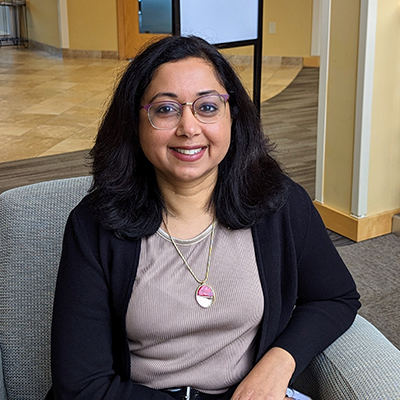
“I am very intentional about implementing AI tools to their full potential while always keeping the work supervised by humans,” explained Dr. Domalpally. “AI should augment the expertise of our graders, not replace it, as they focus on the more complicated tasks requiring human judgement and expertise.”
Dr. Domalpally carries with her the same principles as WRC founder, Matthew Davis, MD: The work of the Wisconsin Reading Center is to be objective, masked, and neutral, with no biases for or against the outcome of any trial. Part of upholding this neutrality means bringing in an unorthodox group to carry out the work.
“The reading center, since its inception more than 50 years ago, has always followed a routine of not having ophthalmologists do the grading,” Dr. Domalpally explained.
According to Dr. Domalpally, individuals with creative interests and great attention to detail make up most of the graders at the WRC, as those qualities are pertinent for recognizing patterns as drug trials progress. Dr. Domalpally champions this approach, affectionately likening graders to ‘human AI.’
“Our graders are not making a diagnosis or taking care of the patient,” she said. “They are trained to do one thing exceptionally well: objective reproducible pattern recognition from retinal images.”
While technology has changed exponentially since Dr. Domalpally originally joined the center, the standard of quality is maintained by the employees—from imaging to grading to operational support.
As Dr. Domalpally steps into her new role, she does so with humility and appreciation for all aspects of the WRC. Beyond grading, finance, bids, statistics, human resources, imaging, and quality assurance all have roles to play to ensure that the WRC retains its reputation as a global leader in image reading.
The WRC is in a place of rapid growth, and Dr. Domalpally’s vision for its future embodies her guiding principle of measuring what matters. This means making a commitment to utilizing technological advancements to their maximum benefit, as well as the development of more meaningful imaging biomarkers and clinical trial endpoints. Her years of service and her forward-thinking bring promise to the future of the Wisconsin Reading Center.