More than 70% of people worldwide carry Herpes Simplex Virus type 1 (HSV-1) for life. Most know it as the virus behind cold sores—a minor, if annoying, inconvenience. But HSV-1 has a far more serious side that many have never heard of.
It can infect the eye.
In fact, nearly every part of the eye is vulnerable, from the surface of the cornea to deeper ocular structures. What might begin as a minor redness or irritation can escalate into repeated infections, scarring, and even permanent vision loss. HSV-1 is one of the leading infectious causes of blindness worldwide.
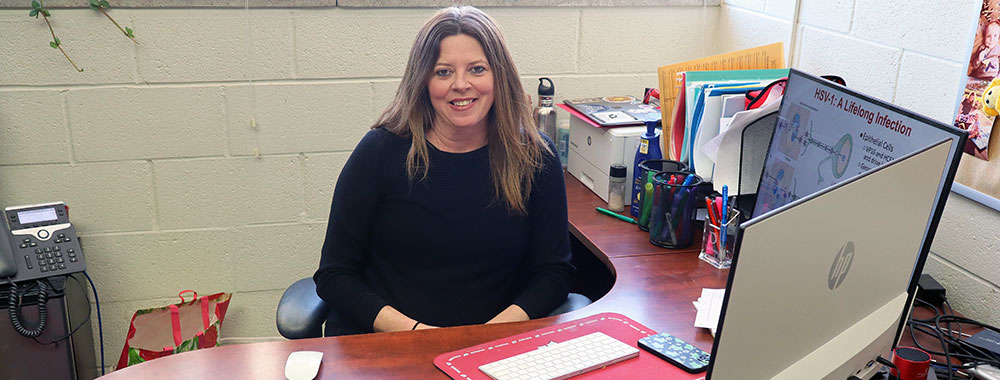
Understanding why—and how to stop it—has become the life’s work of University of Wisconsin–Madison researcher Donna Neumann, PhD. With a new $2.58 million grant from the National Institute of Allergy and Infectious Diseases, Dr. Neumann, an associate professor in the Department of Ophthalmology and Visual Sciences, is tackling one of the virus’s greatest mysteries: how it hides, and what causes it to suddenly return.

“HSV-1 is notorious for its ability to hide silently inside sensory neurons in the peripheral nervous system,” Dr. Neumann said. “After the initial infection, the virus travels along nerve fibers into the nervous system, where it creates latent reservoirs—a biological hideout that allows the virus to evade the immune system and remain dormant for the life of the human host.”
During this dormant phase, the virus produces no symptoms and evades both the immune system and antiviral medications. But it is never truly gone.
Stressors like extreme temperatures, chemical stimulants or emotional stress can cause the virus to reactivate. When that happens, it travels back along nerve pathways to the eye, where it can cause painful flare-ups, including scarring and permanent blindness. Even worse, the newly produced virus can spread to other people, continuing the cycle.
Despite decades of research, one critical question remains unanswered: What flips the switch that wakes the virus up?
Dr. Neumann’s research is beginning to reveal an answer—hidden deep within the virus’s genetic structure.
“Using an advanced genomic technology called Chromosome Conformation Capture circular-sequencing and a specialized human neuron model,” Dr. Neumann explained, “my team has discovered that HSV-1 organizes its DNA into complex three-dimensional shapes, known as viral chromatin loops. We are proposing that these viral chromatin loops act like molecular locks, keeping the virus in a dormant state.”
But under stress, those locks can weaken or break. “When that happens, viral genes turn back on,” Dr. Neumann continued. “That’s when the virus reactivates and begins causing damage again.”
This new grant will enable Dr. Neumann and her team of scientists to explore exactly how these molecular locks work—and how they fail.
The implications of this work are profound.
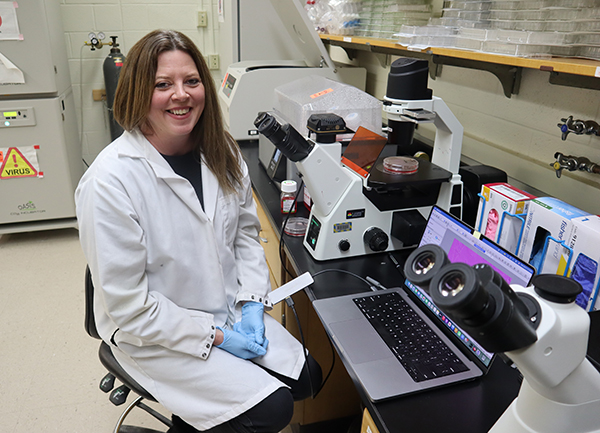
“Our team is not only working to understand how HSV-1 hides,” Dr. Neumann said, “but also how to stop it from ever coming back. By combining our discoveries with advanced gene delivery technologies, we aim to target and eliminate the virus in its dormant state—something no current treatment can do.”
“If successful,” she added, “this approach could prevent recurring eye infections, protect patients from vision loss, and even stop the virus from spreading.”
For millions of people living with HSV-1, it could mean something once thought impossible: a future free from reactivation.