For more than two decades, T. Michael Nork, MD, has been a familiar face on the advisory board of the Lions Eye Bank of Wisconsin (LEBW). As a retina specialist with UW Health and a professor in the University of Wisconsin Department of Ophthalmology and Visual Sciences, he has spent years supporting LEBW’s mission to recover and transplant corneal tissue—helping ensure that surgeons across Wisconsin have the tissue they need to save sight.
Fast forward to 2025. Dr. Nork’s connection to LEBW took on a deeply personal dimension: he became a corneal transplant recipient.
For years, Dr. Nork had noticed gradual changes in his vision. He developed a brunescent cataract—a hardened, darkly pigmented cataract that impairs color perception. “I started experiencing all the things I tell my patients about,” he recalled. “Having trouble seeing at night. Things were darker, like I was wearing sunglasses all the time. Except it wasn’t so cool as when rock stars do it. And not voluntary.”
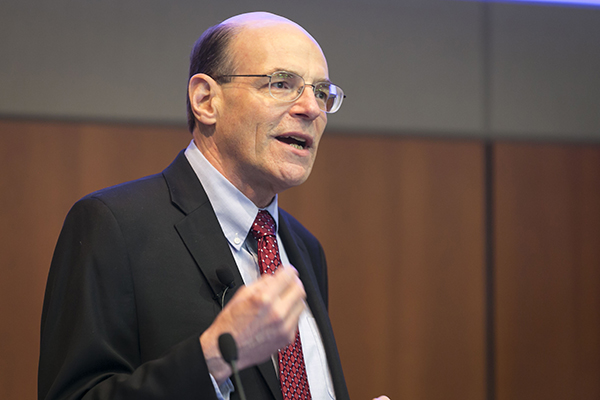
As an ophthalmologist, Dr. Nork knew how to compensate. “My vision was excellent through a microscope,” he said. “So it didn’t impact my work in any way.”
But he also knew the condition wasn’t going to improve on its own. So, in 2024, he decided to do something about it.
He reached out to longtime colleague and respected cornea surgeon, Sarah Nehls, MD. “All the cataract surgeons at UW are excellent,” Dr. Nork said. “But I had personally witnessed Dr. Nehls in action on complicated cases. I knew she didn’t get flustered when problems arose. And operating on a colleague is particularly stressful. I knew she had the ability and experience to handle it—especially if any complications occurred, which in my case, they did.”

In February 2024, Dr. Nork underwent cataract surgery on his left eye using the standard phacoemulsification technique, in which an ultrasonic probe breaks up and removes the cloudy lens through a small incision.
Typically, the second eye is treated within one to two weeks. In Dr. Nork’s case, however, complications during surgery forced a delay. He had an unusually dense cataract, and the procedure also caused damage to the corneal endothelial cells—the delicate inner layer of the cornea that is essential for maintaining clarity.
Despite careful management over the following months, including hypertonic saline and other treatments, his left cornea remained persistently cloudy.
In June 2024, Dr. Nehls performed surgery on Dr. Nork’s right eye using advanced laser technology to soften the cataract before removal.
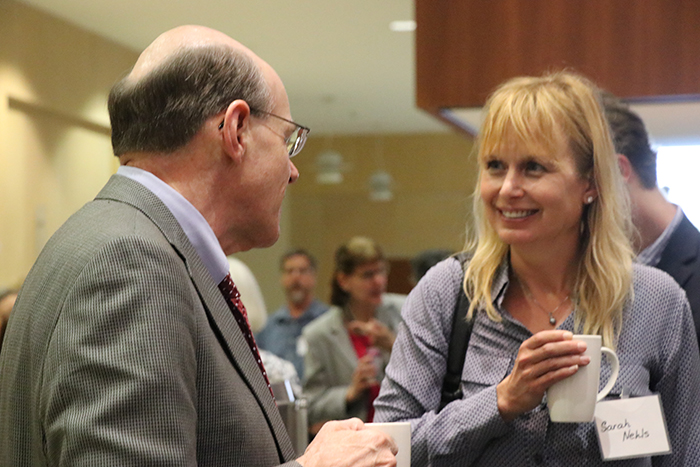
The procedure was successful, and his vision quickly improved to 20/20. The left eye, however, continued to deteriorate—prompting the next step: Descemet Membrane Endothelial Keratoplasty (DMEK), a minimally invasive corneal transplant that replaces only the diseased endothelial layer.
“DMEK is remarkable,” Dr. Nehls explained. “A thin layer of donor endothelial cells is inserted through a tiny incision and positioned with an air bubble. There are no stitches, and recovery is faster with often better vision than older techniques.”
Enter LEBW. They played a critical role, providing and preparing the donor tissue for the procedure.

“For more than two decades, Dr. Nork has been an invaluable member of our Board of Directors and his commitment to LEBW and UW Health has transformed countless lives across Wisconsin and around the world,” said Stacey M. Troha, Chief Executive Officer of the Lions Eye Bank of Wisconsin. “We take immense pride in providing the highest quality corneal tissues but seeing a Wisconsin donor’s generous gift directly restore Dr. Nork’s vision is profoundly special. It ensures he can continue his own legacy of saving sight and educating the next generation of eye care professionals. This is a beautiful gift to be grateful for, and a legacy we are so proud to support.”
Dr. Nork underwent DMEK surgery on his left eye in May 2025. Both the procedure and recovery went smoothly.
“I had to lay flat on my back for 24 hours after surgery,” Dr. Nork said. “That was the hardest part.”
Within two months, he was seeing 20/20 in his left eye. And his vision has continued to improve.
“The colors I see now are amazing,” he said. “It’s shocking the difference, especially with blues and yellows.”
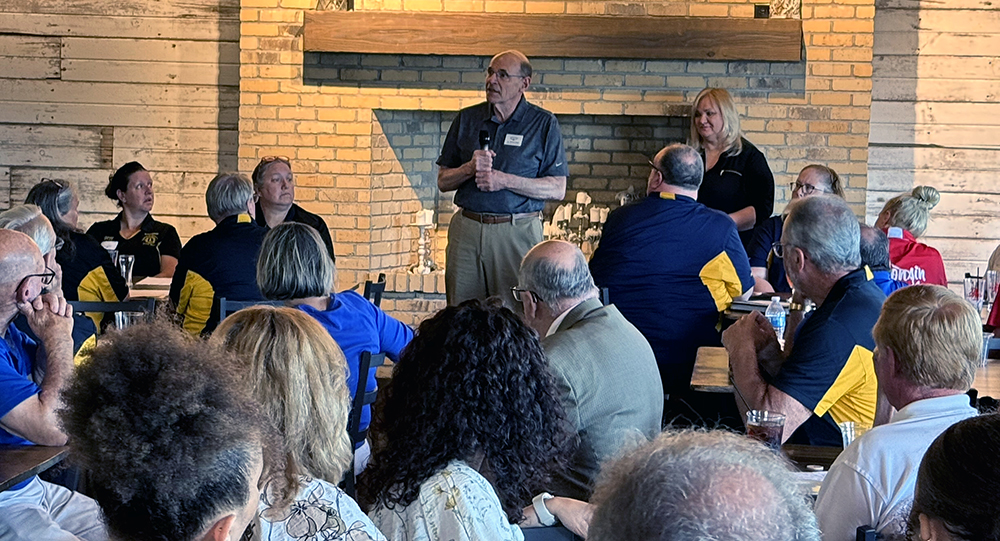
Reflecting on his journey, Dr. Nork emphasizes the incredible advancements in modern cataract and corneal surgery. “Most cataract procedures today are quick, easy, and virtually painless. Complications are rare unless surgery is delayed too long. When it’s time, it’s time—get it done.”
“I am so appreciative of Dr. Nehls and Lions Eye Bank of Wisconsin,” he added. “I can’t thank them enough. I often ask myself—what had I been missing all this time!”