The UW-Madison Department of Ophthalmology and Visual Sciences and the McPherson Eye Research Institute at UW-Madison are pleased to announce the recruitment of Jianhai Du, PhD. Dr. Du joined the Department of Ophthalmology and Visual Sciences as Associate Professor with tenure on July 1, 2026, and serves as the McPherson Eye Research Institute’s inaugural Monroe E. Trout, Jr. Chair in Eye Research. The new Trout Chair, made possible by the generosity of Sandra Trout and the late Monroe Trout of Appleton, WI, is the fourth endowed Chair that the Trout family has established within the McPherson Eye Research Institute.
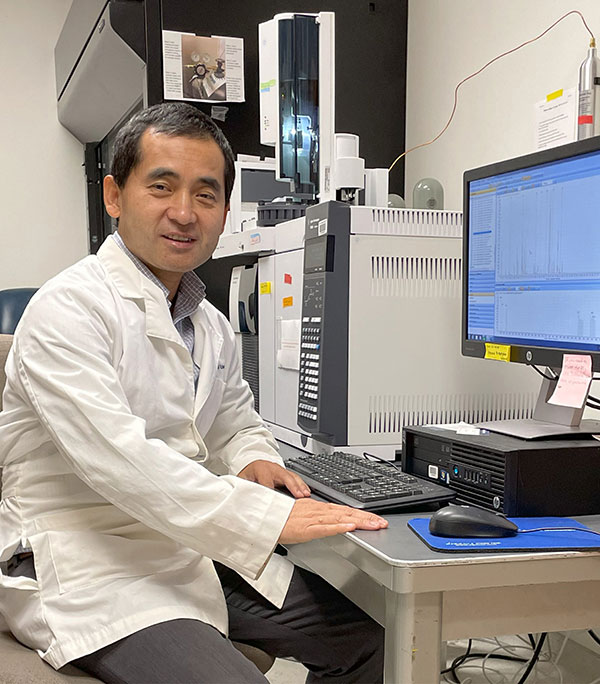
Dr. Du comes to UW–Madison from West Virginia University where he pioneered the field of retinal metabolism and its role in retinal degeneration, particularly age-related macular degeneration (AMD). Over nearly a decade, Dr. Du built a successful, continuously well-funded research program, collaborating with more than 20 different vision research laboratories. His laboratory’s studies of cell-specific nutrient metabolism and the metabolic ecosystem of the retina and retinal pigment epithelium have greatly advanced our understanding of how metabolic dysfunction contributes to vision loss. To date, Dr. Du has published 54 peer-reviewed articles describing work that bridges fundamental and translational science, with the goal of developing metabolism-based strategies to prevent or slow retinal degeneration. At UW-Madison, Dr. Du will build on his previous work to advance innovative AMD research and develop new strategies to treat this devastating and prevalent blinding condition.
Dr. Du completed his Ph.D. in Pathophysiology at Peking University, Beijing, China; M.S. in Physiology at Lanzhou University, Lanzhou, China; and B.A. in Literature at Nanjing Normal University, Nanjing, China. His postdoctoral training includes appointments at the Medical College of Wisconsin and the University of Washington, followed by faculty positions at the University of Washington and West Virginia University. In addition to his research accomplishments, he is a dedicated educator and mentor committed to training the next generation of vision scientists.