Our ability to see clearly depends on an extraordinary partnership between cells in the retina. At the center of that partnership is the retinal pigment epithelium, or RPE—a layer of cells that nourishes the retina, recycles nutrients, and helps keep the light-sensing cells essential for vision healthy.
Scientists are increasingly finding that this metabolic partnership may hold important clues to why the retina becomes damaged with age and in diseases such as age-related macular degeneration (AMD).
The retina is one of the most metabolically active tissues in the body. Its light-sensing cells, called photoreceptors, require a constant supply of energy and nutrients to function. The RPE helps meet those demands by processing and recycling a variety of nutrients and using alternative sources of energy. In doing so, it helps preserve glucose for the photoreceptors, while also transporting nutrients to the retina and clearing away cellular waste.
When this carefully balanced system begins to break down, the consequences can be serious. Metabolic dysfunction in the RPE may contribute to the buildup of fatty deposits beneath the RPE, deprive photoreceptors of the support they need, and ultimately contribute to the loss of central vision that occurs in AMD and other retinal degenerative diseases.
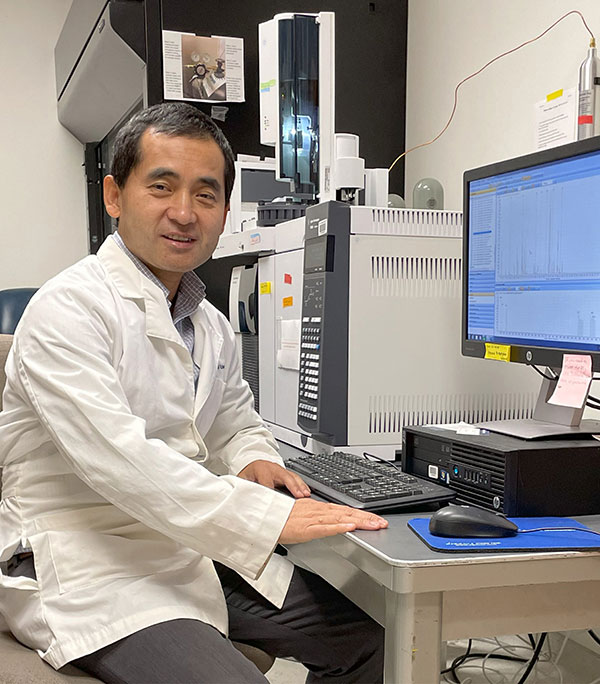
Understanding how this metabolic partnership works—and what causes it to fail—is the focus of research by Jianhai Du, PhD, of the University of Wisconsin Department of Ophthalmology and Visual Sciences.
Throughout his career, Dr. Du has worked to understand how nutrients are processed and shared within the retina. His research has helped reveal that the RPE and neural retina function as an interconnected metabolic ecosystem, with each relying on the other to maintain a healthy environment for vision.
One promising piece of this puzzle is an enzyme called nicotinamide N-methyltransferase, or NNMT.
“We found that NNMT is highly active in the RPE, where it appears to help these cells use a variety of nutrients for energy,” Dr. Du said. “This flexibility may be an important part of how the RPE maintains a healthy environment for the retina.”
But, as Dr. Du and his collaborators have discovered, more activity is not necessarily better.
NNMT activity in the RPE increases four- to 10-fold in patients with AMD and Sorsby Fundus Dystrophy, a rare inherited retinal disease. When NNMT becomes excessively active, it may consume molecules that cells need to produce energy and maintain normal function.
In other words, an enzyme that helps the RPE adapt to changing metabolic demands may become harmful when its activity is pushed too far.
Dr. Du describes NNMT as a potential “Goldilocks” regulator: its activity needs to be balanced. Too little may impair the RPE’s ability to adapt, while too much may disrupt metabolism and contribute to retinal degeneration.
To better understand this balance, Dr. Du is collaborating with Jennifer Chao, MD, PhD, at the University of Washington. Together, they are investigating when NNMT supports a healthy retina, when it becomes harmful and whether restoring a healthier level of NNMT activity could protect the aging retina.
A new four-year, $2.4 million research award from the National Eye Institute will help advance this work.
The research team will combine advanced metabolic tracing and mass spectrometry with studies of mouse models and human RPE cells derived from patients. They will also test potential ways to modify NNMT activity and determine whether doing so can preserve retinal structure and function.
The goal is bigger than understanding a single enzyme. By uncovering how the RPE maintains the metabolic support the retina needs—and what happens when that system fails—Dr. Du and his collaborators hope to reveal new ways to protect retinal health.
“By revealing how metabolism changes in aging and retinal disease, this research could identify new biological targets for future treatments for AMD and other retinal degenerative diseases,” Dr. Du said. “Ultimately, we hope these discoveries will help us find new ways to preserve the health of the retina and protect vision as we age.”
For millions of people at risk of vision loss, understanding the retina’s metabolic lifeline could be an important step toward protecting sight for years to come.